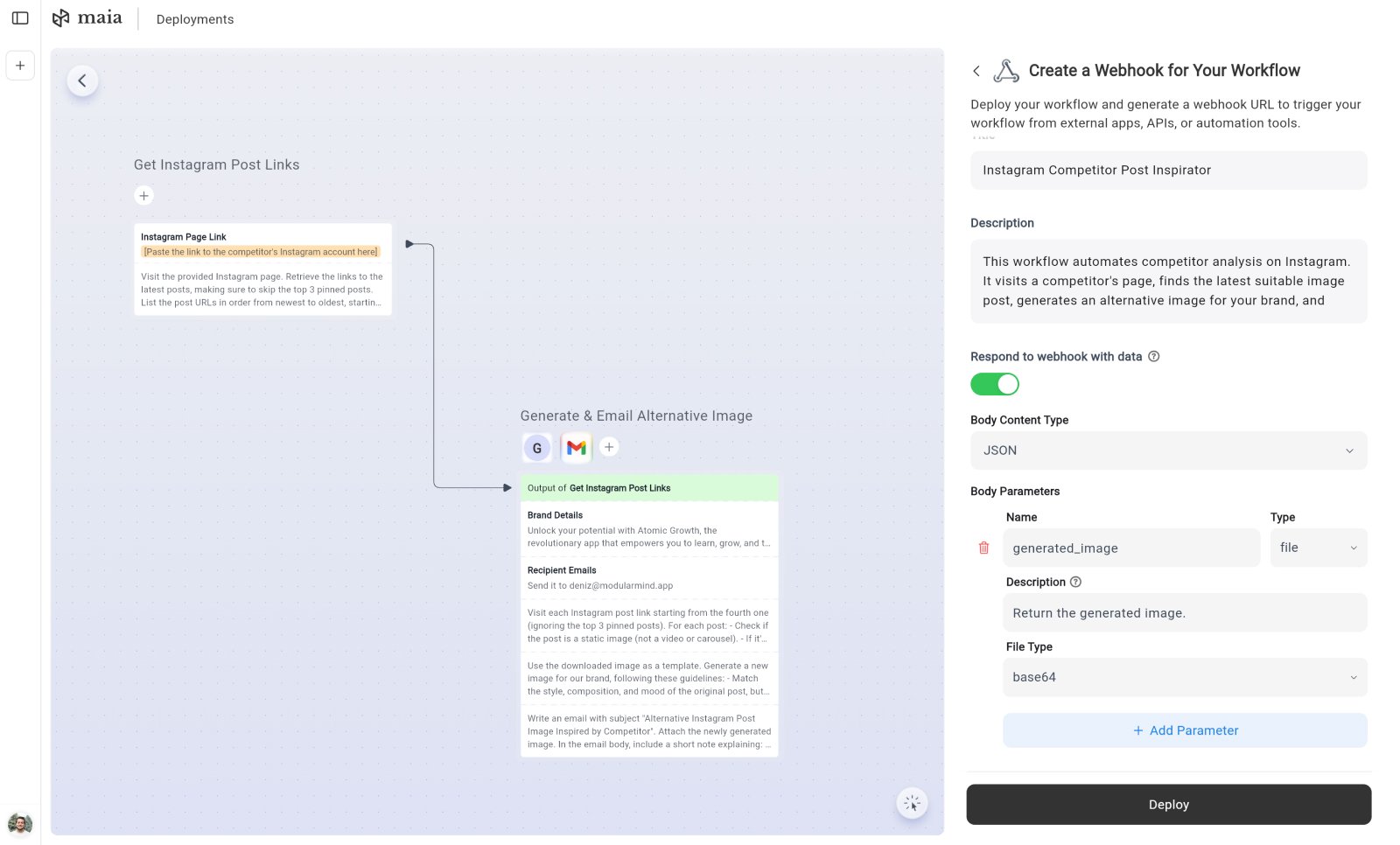
Event-Driven Automation Webhooks turn Maia workflows into intelligent APIs that respond to external events — form submissions, payment notifications, chat messages, and more.
With webhooks, Maia becomes a serverless backend that processes inbound requests with AI-powered logic and returns structured responses.
How Webhooks Work Basic Flow
Create Webhook
Deploy a workflow with webhook trigger Maia generates a unique URL: https://hooks.modularmind.app/hooks/0nMMaZgKjmOirqosc8ohkeCuw9cV
External Event
Another system sends data to your webhook URL curl -X POST https://webhooks.maia.app/wh_abc123xyz \ -H "Content-Type: application/json" \ -d '{"email": "john@example.com", "message": "Interested in demo"}'
Maia Processes
Your workflow receives the payload and executes
Parse incoming data
Run AI analysis, research, or generation
Use actions
Stream Response
Maia streams back the result via SSE events event: response data: {"status":200,"contentType":"application/json","body":"{\"lead_score\":85,\"recommendation\":\"High priority - schedule demo ASAP\"}"} event: done data: {}
Creating Webhook-Triggered Workflows Simple Example: Lead Enrichment Goal: When a contact form is submitted, enrich the lead data before adding to CRM.Workflow: 1. Receive form data (name, email, company) 2. Research company online (industry, size, funding) 3. Check LinkedIn for person's role 4. Calculate lead score (1-100) 5. Add to CRM with enriched data 6. Return lead score and priority
Deployment: Maia provides webhook URL: https://hooks.modularmind.app/hooks/L3wKjb7iEMFTwMJFZsroWsSoc731
Usage:
Your website form submits to this URL and receives an SSE stream. Once complete, the parsed response body contains:{ "lead_id" : "CRM_12345" , "score" : 92 , "priority" : "hot" , "reason" : "Decision maker at Series B SaaS company" }
Inbound Payload: Flexible Schema Unlike traditional APIs that require strict schemas, Maia webhooks are intelligent .
Maia Understands Context Send any data format, and Maia figures it out:
JSON Object
Form Data
File Upload
Image Upload
Multiple Files
Files in JSON
ZIP Archive
Complex JSON
{ "customer_email" : "jane@example.com" , "subject" : "Need help with billing" , "message" : "I was charged twice this month" }
Maia extracts: email=jane@example.com&subject=billing&message=charged+twice
Maia converts to structured format automaticallyContent-Type: multipart/form-data file: invoice.pdf description: "Please process this invoice"
Maia receives file, extracts dataContent-Type: multipart/form-data file: screenshot.png description: "Analyze this image"
Maia detects and processes JPEG/PNG images automaticallyContent-Type: multipart/form-data file1: contract.pdf file2: receipt.jpg file3: notes.txt description: "Process all these documents"
Maia handles multiple files in a single request{ "invoice" : { "filename" : "invoice.pdf" , "content" : "base64EncodedData..." , "encoding" : "base64" }, "supporting_docs" : [ { "filename" : "receipt.jpg" , "data" : "binaryData..." } ] }
Maia processes files embedded in JSON (base64 or raw binary)Content-Type: multipart/form-data file: documents.zip instructions: "Extract and analyze all contents"
Maia automatically extracts ZIP files and processes contents (PDFs, images, text files){ "order_id" : "12345" , "customer" : { "name" : "John Doe" , "contact" : { "email" : "john@example.com" } }, "items" : [ { "product" : "Widget" , "qty" : 5 } ], "attachments" : { "receipt" : "base64Data..." } }
Maia understands arbitrary nested JSON structuresOutbound Response: Controlling What Gets Returned When deploying a webhook, you choose how Maia responds to incoming requests.
If you don’t enable “Respond to webhook with data” , Maia returns immediately with one of these standard responses:
Success: { "type" : "success" , "message" : "Workflow execution triggered successfully." }
Error (Invalid Endpoint): { "type" : "error" , "code" : "invalid_endpoint" , "message" : "Invalid endpoint. Please check the path and try again." }
Error (Disabled Endpoint): { "type" : "error" , "code" : "endpoint_disabled" , "message" : "This endpoint is currently disabled." }
The workflow executes asynchronously, but the caller doesn’t wait for results.
Custom Data Response (SSE Streaming) Enable “Respond to webhook with data” to return workflow outputs back to the caller via Server-Sent Events (SSE) .
When enabled, you define Body Parameters — exactly like configuring Custom Actions . This tells Maia what data to include in the response.
Maia uses SSE streaming instead of a standard JSON response. This keeps the connection alive while the workflow executes, preventing timeouts on long-running workflows.
Connection Protocol When a webhook with response data enabled receives a request, the connection follows this lifecycle:
SSE Connection Established
The server responds with 200 OK and SSE headers: Content-Type: text/event-stream Cache-Control: no-cache Connection: keep-alive
Heartbeats During Processing
While the workflow executes, the server sends periodic heartbeat comments every 15 seconds to keep the connection alive: These are SSE comments and should be ignored by your client.
Response Event
When the workflow completes, the server sends a response event containing the result: event: response data: {"status":200,"contentType":"application/json","body":"{...}"}
For text-based responses (application/json, text/*), the body field contains the raw string. For binary responses (images, PDFs, ZIPs), the body is base64-encoded and an encoding: "base64" field is included.
Done Event
A done event signals the stream is complete: The connection closes after this event. Error Handling If the workflow fails to trigger, the server sends an error event instead:
event: error
data: {"type":"workflow_trigger_failed","message":"Failed to trigger workflow execution."}
Client Implementation Example const eventSource = new EventSource ( 'https://hooks.modularmind.app/hooks/your_hook_id' , { method: 'POST' , headers: { 'Content-Type' : 'application/json' }, body: JSON . stringify ({ email: 'john@example.com' }) }); // Note: EventSource only supports GET requests. // For POST requests, use fetch with a manual SSE parser: const response = await fetch ( 'https://hooks.modularmind.app/hooks/your_hook_id' , { method: 'POST' , headers: { 'Content-Type' : 'application/json' }, body: JSON . stringify ({ email: 'john@example.com' }) }); const reader = response . body . getReader (); const decoder = new TextDecoder (); while ( true ) { const { done , value } = await reader . read (); if ( done ) break ; const text = decoder . decode ( value ); const lines = text . split ( ' \n ' ); for ( const line of lines ) { if ( line . startsWith ( 'event: ' )) { const eventName = line . slice ( 7 ); // Next data: line contains the payload } if ( line . startsWith ( 'data: ' )) { const data = JSON . parse ( line . slice ( 6 )); // Handle event data } } }
Supported Response Types Maia can return:
Text data in JSON format (structured responses) — delivered as-is in the body fieldImages (JPEG, PNG) — base64-encoded in the body field with encoding: "base64"Text files — delivered as-is in the body fieldPDFs — base64-encoded in the body field with encoding: "base64"ZIP files — base64-encoded in the body field with encoding: "base64"
Data, including files, can be generated throughout the workflow or downloaded from external sources.
Defining Response Parameters For each parameter you want to return, specify:
Name : The field name in the response (e.g., lead_score, generated_image, report_pdf)Description : Natural language explanation of what this field contains and where Maia should get the value from. This helps Maia understand which workflow outputs map to this response field.Type : The type of data (text, file, etc.)Response parameter definitions work identically to body parameters in Custom Actions . See that section for detailed parameter configuration guidance. Example: Lead Scoring Response Configuration: Body Parameters: - Name: lead_id Description: The CRM record ID assigned to this lead - Name: score Description: Calculated lead score from 1-100 based on company research - Name: priority Description: Priority level (hot/warm/cold) based on the score - Name: next_action Description: Recommended follow-up action for the sales team
SSE Stream: : heartbeat : heartbeat event: response data: {"status":200,"contentType":"application/json","body":"{\"lead_id\":\"CRM_54321\",\"score\":88,\"priority\":\"hot\",\"next_action\":\"Schedule demo within 24 hours\"}"} event: done data: {}
Parsed Response Body: { "lead_id" : "CRM_54321" , "score" : 88 , "priority" : "hot" , "next_action" : "Schedule demo within 24 hours" }
Example: Document Generation Response Configuration: Body Parameters: - Name: report_pdf Description: The generated PDF report file created by the workflow Type: File (base64) - Name: summary Description: Brief text summary of the report contents
SSE Stream: : heartbeat : heartbeat : heartbeat event: response data: {"status":200,"contentType":"application/json","body":"{\"report_pdf\":\"base64EncodedPdfData...\",\"summary\":\"Q4 2025 Sales Report - 23% growth, top performer: Enterprise segment\"}","encoding":"base64"} event: done data: {}
Parsed Response Body: { "report_pdf" : "base64EncodedPdfData..." , "summary" : "Q4 2025 Sales Report - 23% growth, top performer: Enterprise segment" }
Real-World Webhook Examples Example 1: Intelligent Chatbot Backend Setup: Website chat widget → Maia webhookWorkflow:
Receive visitor message
Search knowledge base using custom action
If found: Generate helpful response
If not found: Create support ticket via custom action, send notification
Return response to chat widget
Request from caller: { "visitor_id" : "vis_123" , "message" : "What's your refund policy?" , "page_url" : "/pricing" }
SSE stream received by caller: : heartbeat event: response data: {"status":200,"contentType":"application/json","body":"{\"response\":\"We offer a 30-day money-back guarantee on all plans. If you're not satisfied, contact support@company.com for a full refund.\",\"confidence\":0.92,\"escalate\":false,\"source\":\"Help Center: Refund Policy\"}"} event: done data: {}
Parsed response body: { "response" : "We offer a 30-day money-back guarantee on all plans..." , "confidence" : 0.92 , "escalate" : false , "source" : "Help Center: Refund Policy" }
Result: Instant, accurate responses powered by AI, with human fallback.Example 2: Invoice Processing Setup: Email automation → Maia webhookWorkflow:
Receive invoice PDF as attachment
Extract data (vendor, amount, due date, line items)
Validate against purchase order using custom action
Add to accounting system via custom action
If > $5000, create approval request via custom action
Return processing summary
Request from caller: { "from" : "vendor@supplier.com" , "subject" : "Invoice #12345" , "attachment_url" : "https://storage.../invoice.pdf" }
SSE stream received by caller: : heartbeat : heartbeat event: response data: {"status":200,"contentType":"application/json","body":"{\"status\":\"processed\",\"invoice_number\":\"12345\",\"vendor\":\"ABC Supplier\",\"amount\":3250.00,\"due_date\":\"2026-01-15\",\"accounting_id\":\"INV_789\",\"approval_required\":false,\"line_items\":[{\"description\":\"Widget A\",\"quantity\":100,\"price\":25.00},{\"description\":\"Widget B\",\"quantity\":50,\"price\":15.00}]}"} event: done data: {}
Parsed response body: { "status" : "processed" , "invoice_number" : "12345" , "vendor" : "ABC Supplier" , "amount" : 3250.00 , "due_date" : "2026-01-15" , "accounting_id" : "INV_789" , "approval_required" : false , "line_items" : [ { "description" : "Widget A" , "quantity" : 100 , "price" : 25.00 }, { "description" : "Widget B" , "quantity" : 50 , "price" : 15.00 } ] }
Result: Automated invoice processing with data extraction and validation.Example 3: Product Review Aggregator Setup: Product review form → Maia webhookWorkflow:
Receive review text and rating
Analyze sentiment (positive/negative/neutral)
Extract key themes (quality, pricing, support, etc.)
Check for spam/fake reviews
If legitimate, publish to website via custom action
If mentions bug/issue, create support ticket via custom action
Return analysis
Request from caller: { "product_id" : "prod_456" , "rating" : 4 , "review" : "Great product! Works as advertised. Customer support was responsive when I had a question about setup. Only issue: shipping took longer than expected." , "reviewer_email" : "customer@example.com" }
SSE stream received by caller: : heartbeat event: response data: {"status":200,"contentType":"application/json","body":"{\"approved\":true,\"spam_score\":0.05,\"sentiment\":\"positive\",\"themes\":{\"product_quality\":\"positive\",\"customer_support\":\"positive\",\"shipping_speed\":\"negative\"},\"action_items\":[{\"type\":\"feedback\",\"category\":\"shipping\",\"message\":\"Customer experienced slow shipping\"}],\"published_url\":\"https://site.com/reviews/rev_123\"}"} event: done data: {}
Parsed response body: { "approved" : true , "spam_score" : 0.05 , "sentiment" : "positive" , "themes" : { "product_quality" : "positive" , "customer_support" : "positive" , "shipping_speed" : "negative" }, "action_items" : [ { "type" : "feedback" , "category" : "shipping" , "message" : "Customer experienced slow shipping" } ], "published_url" : "https://site.com/reviews/rev_123" }
Result: Intelligent review moderation with actionable insights.
Next: Security & Privacy Learn how Maia protects your data and credentials